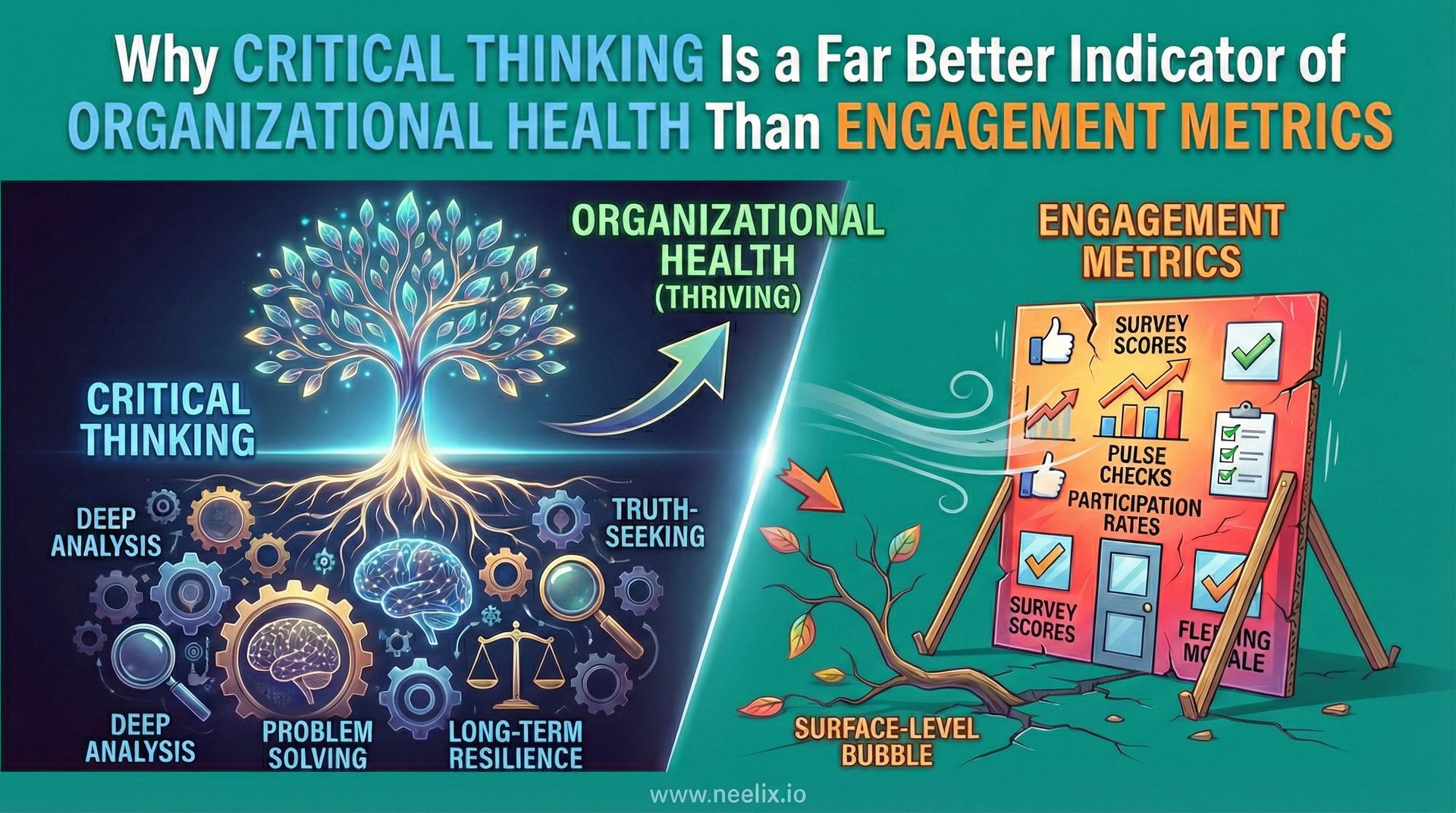
Why Critical Thinking Is a Far Better Indicator of Organizational Health Than Engagement Metrics
The Future of Engagement Isn’t Surveys - It’s Critical Thinking
Let’s be honest: traditional “employee engagement” metrics - surveys, pulse scores, recognition counts, kudos - are not a reliable foundation for building a truly effective team culture. They too often yield biased, stale or superficial data. Meanwhile, developing critical thinking across your workforce - and embedding it structurally - delivers real impact: driving continuous improvement, informing strategic decisions, nurturing psychological safety, and building an adaptive, high-value culture.
If you are a believer in the behavioral and people-oriented (not metric-oriented) approach to driving teams through the maturity curve, read on. In this post we’ll explain my perspective on why critical thinking - facilitated through a living, evidence-based network - is a far better measure and path for organizational health than engagement scores.
Why traditional employee engagement metrics fall short
There is long-standing evidence and organisational experience that show common pitfalls of traditional engagement efforts. There is a long-standing evidence of how organisational culture and engagement stack up:
- Up to
70% of employees are disengaged (Gallup surveys) despite the doubling-down on traditional approaches (that is evidence enough that they are lacking).
- Many younger workers (e.g. 35 % of Gen Z, 28 % of millennials in Deloitte’s survey) report feeling mentally distanced or cynical about their work.
- Conventional survey-driven engagement programs perform poorly: only 22% of companies get useful results from their engagement surveys, and organizational willingness to act is often limited: only 42% of organizations say they are willing to act on every single survey question. (LeadershipIQ online quiz - “How Good Is Your Employee Engagement Survey?”).
Adding to that, day to day experience shows serious drawbacks when engagement efforts rely heavily on external interventions, discrete surveys or top-down recognition initiatives.
In short: many organizations double down on engagement as if it were culture - but engagement metrics often don’t measure what truly matters: whether employees think, challenge, reflect, innovate and learn. "When a measure becomes a target, it ceases to be a good measure" - Goodhart's law.
Worse: traditional approaches are used to create the illusion of a “healthy” workforce - masking disengagement, cynicism, or shallow compliance - because they don’t capture the internal, qualitative dynamics that drive real performance.
Why critical thinking - and structural dialogue - matters more
Collective intelligence outperforms static engagement
The concept of Collective Intelligence offers a better paradigm. As explained in a previous blog related to developing collective intelligence: when teams think together, generate shared insights, and make smarter decisions - that’s real engagement (that’s where real organizational value emerges).
Everyone seems to buy into the notions that enabling collective intelligence, organizations tap into the combined brainpower of many: pooling diverse perspectives and experiences, surfacing blind spots, enabling continuous improvement and adaptive decision-making. How many are actually brave enough to do it, or have the discipline?
Culture, autonomy and avoiding managerial overload
Traditional engagement often reinforces old-style hierarchical control: surveys, checklists, recognition programs - but those don’t create real culture. People need less psychometric tests, surveys, games - they need more adult dialogue.
Culture built on rigid rules and rituals becomes brittle; true culture arises from authenticity, systems thinking, and the freedom for individuals to act in line with shared values.
Critical thinking, open dialogue and collective intelligence let teams self-organize, own their problems, identify bottlenecks, suggest improvements - reducing dependency on top-down interventions.
Why “Critical-thinking network” is the modern engagement
It’s time to stop treating engagement as a KPI and start treating it as a living process - one that thrives on continuous reflection, feedback, and sense-making. That’s what a “living engagement network” does.
In our experience, real organizational health comes from:
- Systems that capture
contextual, real-time feedback and reflections - not just tick-the-box survey responses.
- Psychological safety and trust - encouraging honesty, dissent, debate.
- Mechanisms for continuous improvement, learning, collective responsibility.
- Data-driven but human-centric insights: enabling leaders to see patterns, not just snapshots.
That’s why the shift from “proof of performance” to “proof of value” is so fundamental.
And why the future of engagement is not “more surveys” - but “platforms for critical thinking, transparency, collective intelligence.”
How Neelix enables this shift - and makes critical thinking measurable
That’s where the Neelix platform comes in. Neelix is unique because it doesn’t just measure “how engaged employees say they are”. Rather, it enables a network of connected people to continuously reflect, share, critique, and contribute - building a living culture of critical thinking. We empower a modern way to support distributed dialogue in organizations.
The process of critical thinking is the ultimate process of engagement.
The payoff - for culture, performance, retention and growth
By making critical thinking a structural - not episodic - part of work life, Neelix turns employee engagement into a continuous journey: one of learning, adaptation, mutual trust, collective ownership.
Instead of relying on static metrics, leaders see how culture evolves, where engagement is real, when teams get stuck, and where interventions (if needed) should happen.
The result: improved decision quality, better coordination, higher empowerment, reduced churn, stronger alignment, and ultimately - a more resilient, value-driven organisation.
For real impact, measure critical thinking - not just sentiment
In the age of complexity, fast change, and hybrid/human-centric workplaces, traditional engagement metrics are inadequate. They are “lagging” by design. Winning organisations rely on “leading” indicators - this the essence of critical thinking.
Metrics don’t drive performance. The motion is continuous - it is rooted in the ability of people to think, challenge, reflect, collaborate, and grow together.
Critical thinking in the workplace represents continuous dialogue, transparent feedback and shared sense-making. It forms the foundation of adaptive culture, strategic decision-making, and long-term performance.
If you’re serious about building an organisation that learns, evolves, and stays ahead - you need more than engagement scores. It is of mild interest to see engagement metrics move from 60 to 65% (especially that the 100% is not the continuous target). However, it would be much more interesting to see any changes in the percentage of critical thinking, and without the need to conduct surveys.
You need a platform that captures the real pulse of your organisation: one built around critical thinking. That’s why Neelix is more than a tool - it’s the next-generation engagement ecosystem.
Ready to make the shift? Explore Neelix and see how critical thinking can become your organization’s most valuable metric.
Share