A New Approach to Coaching: AI-Augmented Feedback for People and Culture Development
Part 2 - From Critical Thinking to Collective Intelligence
In the first part of this series, “Critical Thinking Is a Massively Better Indicator”, we explored why organisations that rely on traditional engagement metrics, surveys, and static frameworks are increasingly blind to what actually determines performance, adaptability, and culture health.
This follow-up article focuses on how modern organisations can operationalise a better approach - one that moves beyond episodic coaching, intervention, compliance-driven HR practices, and well-intended but sometimes ineffective development programs. At the centre of this shift is a new understanding of coaching grounded in collective intelligence and assisted by Ai augmentation.
The Structural Problem With Traditional Consultancy and Coaching
No matter how capable individual consultancies and coaches are, the reality is consistent across industries: Coaching impact fades once the coach leaves.
Coaches do intend to grow capability and change from within. However, clients often “force” coaches to tip toe and provide temporary pain killers. It does happen that organisations seek “easy” solutions to guide the engagement with statements such as “just tell us what to do”. This breaks coaching. In addition, not all leaders are capable of genuine self-reflection and rapid change.
Traditionally, organisations treat coaching as:
- A time-bound intervention
- A specialist activity owned by HR
- A corrective measure for individuals rather than a developmental system for teams
As a result, behavioural change rarely sticks. Old habits resurface. Teams revert to familiar patterns. The organisation remains dependent on external expertise to “fix” what is fundamentally a systemic challenge.
This mirrors a broader truth: Capability cannot be bought or imported. It must be grown internally.
Sustainable performance emerges only when self-reflection at organisational level is embedded into the operating model itself - not delivered as a service or an HR process on the side.
Why Traditional Models No Longer Scale
Conventional people development relies heavily on tools and practices that are no longer fit for the complexity of modern organisations:
- Periodic surveys that capture sentiment too late
- Psychometric assessments that freeze people into static categories, and do not facilitate what happens to fluid situations
- One-off workshops that lack continuity
- Top-down feedback filtered through hierarchy and politics
These approaches are slow, biased, and often disconnected from day-to-day reality. Worse, they can create an illusion of progress while reinforcing the status quo.
Trying to build adaptive, high-performing organisations with these tools is like trying to move global logistics using horse-drawn carriages in the age of high-speed rail.
The Shift: From “Managing” Individuals to Enabling Collective Intelligence
The most effective organisations are making a fundamental shift:
From managing individuals → to enabling systems of thinking.
This is where real-time feedback systems and innovative AI-augmentation become transformative - not as replacements for human judgment and mentoring, but as amplifiers of it.
Instead of treating feedback as an occasional event, modern organisations treat it as a continuous flow of insight embedded in everyday work. In this model:
- Every employee becomes a
sensor in the system
- Every interaction contributes to shared understanding
- Every team develops the capacity to self-correct and self-improve
This is what collective intelligence looks like in practice.
What Makes Modern Feedback Fundamentally Different
A modern feedback loop is not a better survey. It is a different paradigm altogether.
1. Real-time and contextual
Feedback is captured in the moment, while context is still intact - not weeks later when memory and meaning are distorted.
2. Focused on critical thinking, not complaints
Rather than collecting opinions or grievances, the system surfaces reasoning, patterns, and decision quality. It helps people reflect on
how they think, not just
what they feel.
3. Designed for self-coaching
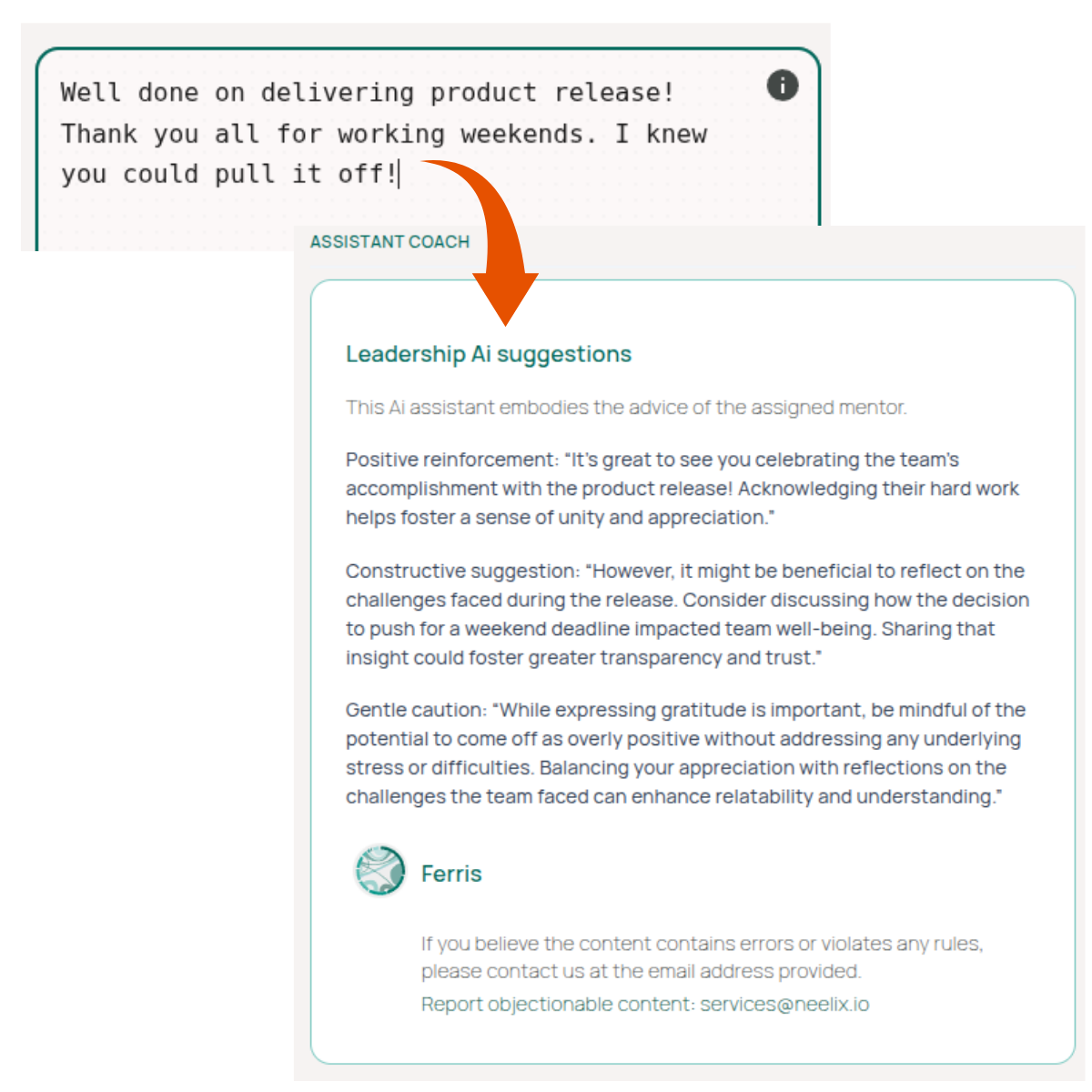
Teams and individuals receive insights from carefully curated Ai-augmentation that help them self-correct without constant managerial intervention. This accelerates learning while reducing leadership load.
3. Scale-able coaching and mentoring
Experienced coaches and mentors still play the important part. Apart from fostering conversations and change, they are able to “clone” themselves into Ai-assistants, thus making the proactive and customised advice to be ever present within the feedback loop flows. This capability fixes a significant enough portion of issues related to “coach was not here, so everything reverted”.
5. Systemically inclusive
Every voice becomes part of the organisational intelligence - not just the loudest or most senior ones.
Why This Matters for Leaders and HR
When feedback systems are limited to “suggestions” or “appreciation,” they create the illusion of engagement while suppressing meaningful change. Everyone knows what’s wrong, but there is no safe, structured way to surface it constructively.
Over time, organisations become ritualised:
- Problems are discussed but not addressed
- Surveys are completed but not acted upon
- Culture becomes performative rather than lived
A modern approach replaces ritual with responsiveness.
By treating each employee as a neuron in a collective brain, organisations gain something far more powerful than engagement scores: situational awareness, adaptability, and continuous learning at scale.
From Feedback to Foresight
The future of people development is not more psychometric testing - it is better sense-making, freedom of expression and quality of critical thinking.
Neelix feedback platform enables organisations to:
- Detect emerging issues before they escalate
- Identify patterns invisible to human observation alone
- Support leaders with insights rather than opinions
- Build cultures that learn in real time
This is not about automating HR. It is about maturing human feedback and judgment. This approach helps everyone:
- HR can move away from "administration of surveys” to sense-making, and thus become true strategic partner to senior leadership and teams alike
- Managers become less overloaded becomes the process of mentoring benefits from proactive advice that does not require hand-holding
- Employees benefit simply by have a better way to be heard
The New Mandate for Leadership
If organisations want resilience, adaptability, and sustainable performance, they must stop treating development as an HR initiative and start treating it as core infrastructure. Coaching must evolve from an intervention into an operating system. Feedback must evolve from a ritual into a living signal. And people must be recognised not as resources to manage - but as intelligence to be connected. That is the promise of a modern, AI-augmented approach to feedback loops, people and culture development.
And that is how real transformation begins.
Most organizations measure the wrong things when assessing organizational maturity and employee engagement. They focus heavily on industry benchmarks and lagging indicators. High-performing organizations still keep an eyes on benchmarks - but they improve by reflecting on who they were yesterday, and prioritizing leading indicators of growth.
Create your team’s or organisational space in Neelix platform today!
The Neelix platform allows you to customize assistants that provide advice on any theme, trait, behavior or expertise.
When a person creates a post, the assistant provides helpful tips for user to consider. Assistants can be configured to target specific groups of people - for example, a leader's communication style, a professional topic, or team quality.
Imagine configuring coaching assistants:
- How to improve critical thinking content
- Leadership style helper
- Keep attention on technical debt
- How to prioritize being heard over being right
The assistants are configured overseen by coaches. The role of an experienced human being is not demoted, but amplified by making proactive hints more available at the time most opportune time. Creativity of the coach and their ability to write good Ai instructions opens new horizons for fostering change at the grassroots levels.
Share